After recently posting our fifth CleanerVinyl before/after video featuring a track by eminent kraut-jazzer Volker Kriegel we thought, why not post the entire album? Now that it sounds like new after cleaning it with a CleanerVinyl EasyOne setup, it makes for a great example of a successful restoration of a 40 year old vinyl record. And it is awesome music! Check it out here:
Volker Kriegel recorded "House-Boat" in 1978 for the German MPS label (MPS 15535). It is one of our favorite German jazz albums here at CleanerVinyl. It is far ahead of its time, has great melodies and a nice laid back atmosphere. Perfect for some relaxed listening on a Sunday afternoon! Enjoy!

Tuesday, April 23, 2019
Thursday, April 18, 2019
New Before/After Video: George Benson - "No Sooner Said Than Done" on the CTI Release "Bad Benson"
CleanerVinyl was founded by vinyl nuts who at some point realized that they needed a high throughput method for cleaning their massive vintage vinyl intake. Need is the mother of invention, and our first prototype led to CleanerVinyl One (now replaced by an improved design, CleanerVinyl EasyOne). When we buy a vintage record that plays rough, we record our favorite track on that album as it played when we received it. And when the record sounds great after cleaning we declare success, and record it again with the aim to publish before/after cleaning videos to promote the awesomeness of ultrasonic record cleaning.
So when we found "Bad Benson" (CTI 6045) in the bargain bin of a local thrift store we were excited! CTI is one of our favorite labels and our collection probably now contains about 50% of their output of great 1970s jazz. George Benson recorded it in 1974, and we love the track "No Sooner Said Than Done" on the B side. Nice and mellow, perfect for hanging out on a Sunday afternoon!
The record looked good. It did not have any major scratches and so we bought it for $2.99. Happy day, we thought. But when we put it on the platter and played it, it sounded very rough. That meant: Off you go to the ultrasonic, where we cleaned it with one of our new CleanerVinyl EasyOne units in a PS-30A cleaner (we like to use the EasyOne for the occasional cleaning of a single record...very easy to use. Instant gratification!)
And, wow, after our standard 15 min cleaning run in distilled water with a few drops of Kodak Photo-Flo, this record sounded great! Almost like new! So we decided that this one was a great example of the power of ultrasonic cleaning, and we decided to make it the focus of a CleanerVinyl Before/After video! Watch it on YouTube. Enjoy!:
Wednesday, April 17, 2019
Awesome New Customer Review About the CleanerVinyl Easy6 Audiophile Kit with Micron Fluid Filtration!
It is always a happy moment when we receive a happy customer email with a link to a enthusiastic review at CleanerVinyl. Check out Ivan Buzik's review below about cleaning 600 records with the Easy6 Audiophile Kit that he bought a couple months ago. He included this picture that shows the Micron filtration system filter after cleaning 600 records in comparison with a new replacement filter. Impressive!:
 |
| CleanerVinyl Micron filter after cleaning of 600 records (left) in comparison with a new replacement filter (right) |
Review (click open the link below to visit the original posting at YouTube):
I have purchased CleanerVinyl Easy6 system about 2 months ago. Before purchasing I have done some research on another Ultrasonic record cleaning solutions and have decided to go with CleanerVinyl. I talked to Rudy at first, the man behind this invention for advice what system to get (One, Three, Six, Pro, I did not consider Max what is 24 records at a time) and decided for Easy 6 - and that was a good choice. That comes with integrated dry fan and I have added filtration system to it - Micron and that was another good choice. What a big difference from the days when Michael Fremer did his first review of CleanerVinyl system (sometimes in 2016?). No need to empty tank for drying after each clean, just lift al records above the water and lock it at that place and start drying using fan. I was using the same water, just always adding some more to the required level and adding few drops of Kodak Photo-Flo 200 solution. In about 2 weeks I finished cleaning about 600 records with the same filter (see attached photo of the new and used one) and the water was still very clean with no signs of contamination. To clean a batch of 6 records usually took me 1 hour from taking records out from the sleeves, clean and dry them and putting back to new inner record sleeves. Cleaning time I set for 15 minutes and drying for 25 - 28 minutes and that was sufficient even when house temperatures were lower. In the summer time I believe that 20 - 23 minutes will be enough for drying time. Currently I enjoy listening to cleaned records and for some what I play more frequently use just a clean Audioquest anti static record cleaner brush if there is some debris on the record. When time comes, I’ll fill up Ultrasonic Cleaner container with water again and with new filter will clean another batch of records, again about 500-600 of them. Before using Ultrasonic Easy6 record cleaner my primary record cleaning machine was VPI HW-17 for many years. That unit was a big, heavy, like a tank. It did the job but not the same way as CleanerVinyl system does. My records are now pristine clean after using Easy6 system and sound great too. For those of you who are looking for record cleaning system or have traditional one using brush with vacuum I strongly recommend CleanerVinyl. It is a simple but great and inexpensive solution to keep your vinyl collection in a top shape. Ivan Buzik
Tuesday, April 16, 2019
Why Is Using Fluid Filtration a Great Idea When Cleaning Vinyl Records with an Ultrasonic Cleaner?
In the early days of CleanerVinyl we usually replaced the cleaning fluid after a few batches of records. It was common to see dirt accumulate at the bottom of the cleaner after running 10-20 records through it. Of course this depended on how dirty the records were, but even with pretty nicely looking records, after a while we could see some dirt! And of course this made us think about redeposition of dirt during the cleaning process. We also did not like to dump the fluid so often...lugging distilled water bottles around and draining the cleaner all the time also was not our favorite thing to do.
So we designed the CleanerVinyl Micron fluid filtration system, which eliminates this issue. We implemented a high capacity filter with a state-of-the art 1 micron particle size rating (hence the name CleanerVinyl Micron...;-) in a fully in-tank contained package that keeps the liquid where it belongs: Inside the tank...no leakage possible by design! This picture shows the Micron system in action. It circulates a 6 liter tank in about 4 min.
 |
| CleanerVinyl Micron in-tank fluid filtration system. |
The 'high capacity' aspect of the Micron system is a result of using a 'volume filter' (instead of the frequently used small surface filters or sponges, which need to be replaced or cleaned all the time to keep the fluid flowing). A volume filter buries the dirt deeply in pores throughout its volume, and therefore can be used for a long time before it needs to be replaced. We estimate that a Micron filter cartridge is good for more than 1000 records before replacement may need to be considered.
Our volume filters are custom made to have the larges volume possible that can be fit under the records in the tank, and they have a state-of-the-art particle size rating of 1 micron. This means that they filter particles that are larger than one micron (that is about 1/100th of the diameter of human hair) during the first pass through the filter.
But it does not end there: Smaller particles are still filtered out by this type of filter, but the particle may have to pass through it a second or third time to be caught in a smaller pore (these filters have a distribution of pore sizes, and the rating reflects the largest pores they have). The consequence is that there is not really a lower limit to the particle size that can be caught, but it may take a bit longer until smaller than 1 micron particles are finally removed.
In practical terms, this means if you run the fluid continuously through such a filter, it will finally be ultra clean and pretty much all dirt is being removed from it. Consequently, redeposition is essentially eliminated, and the cleaning fluid only very rarely needs to be replaced.
Hence, records can be cleaner almost continuously with the same batch of liquid. That is the perfect solution for record stores and serious collectors who clean large numbers of records for their collections. Check it out at CleanerVinyl.com, the home of ultrasonic vinyl record cleaning!
Sunday, April 14, 2019
What is the Best Vinyl Record Cleaning Method?
At CleanerVinyl we often get the questions "what is the best vinyl record cleaning method?" and "why should I use ultrasonic cleaning?".
The first question is actually not so easy to answer (the second is!-see below)! It really depends what your objective is. If you just want to wipe a bit of lint off the record before playing it, then we would recommend using a carbon fiber brush. If, on the other hand, you want to get a record ready for playing that you bought used in a record store or on ebay/discogs etc..., then a simple brushing does not cut it in most cases.
Then you want to use at least a bit of liquid to help dissolving the dirt out of the grooves. And then ultrasonic is really the way to go! Caked on dirt, mold, fingerprints and similar contamination are difficult to remove with traditional methods since it is difficult to get to the bottom of the grooves with a pad or sponge, or brushed wand, like you find them on classic cleaning devices such as the well-known Spin Clean or devices like the Okki Nokki. This figure shows the principal differences between the cleaning methods:
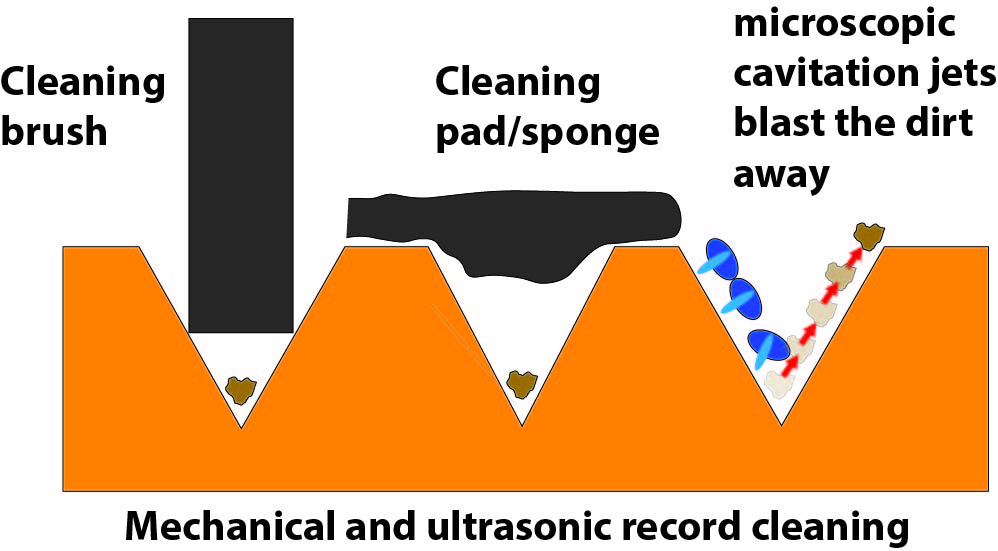 |
| Penetration depth of record cleaning methods. |
The ultrasonic method is able to enter the most intricate of features with its microscopic cavitation bubbles (see our previous post about how ultrasonic cleaning works). Each of these bubbles is a microscopic 'blaster' that blows dirt from the surface. These bubbles are so small, they can easily make it to the bottom of the grooves on the record where they release their cleaning jets. The cleaning fluid then carries the dirt away from the groove. This process can be further enhanced by adding cleaning fluid filtration to the mix. The CleanerVinyl Micron filtration system with its industry leading 1 micron rated particle volume filter is able to remove even the smallest dirt particles from the cleaning fluid while the cleaning process commences. This dramatically reduces the likelihood that a dirt particle makes it back to the surface before the cleaning process is over.
 |
| CleanerVinyl Micron in-tank filtration system. |
The Micron filtration system is able to circulate a 6 liter tank in about 4 min, and a 10 liter tank in about 6 min. This means that the cleaning fluid is pushed several times through the filter during a 15 min cleaning run. Another advantage besides eliminating redeposition is that the cleaning fluid can be used for many batches of records before it needs to be replaced.
Tuesday, April 9, 2019
New Before/After Video: Listen to Kraut-Jazzer Volker Kriegel Before and After Ultrasonic Cleaning
At CleanerVinyl.com we collect a lot of jazz albums. Our business really started out of necessity...our collection grew and we needed to clean the records. And our initial prototype became our first commercial product. The CleanerVinyl One (which has recently been updated and became the EasyOne).
Anyway, recently, we started expanding our collection of 'Kraut-Jazz' and one of this genre's most important musician, Volker Kriegel, has our full attention. We recently bought his album "House-Boat" that he recorded together with Wolfgang Schlüter in 1978 on the MPS (Musik Produziert im Schwarzwald - Music Produced in the Black Forest...;-) label.

This album came via Discogs and was listed as near mint ("NM"). We usually like to buy NM if it is at all affordable, since a good 'mechanical condition' is always the beast starting point before reconditioning an album with your ultrasonic cleaner.
When we received the album, visual inspection yielded a nearly perfect surface, no scratches and very few minor scuffs, probably from the original plain paper inner sleeve (of course we replaced that with a nice Mofi sleeve after we cleaned it!). While looking great, it played pretty rough, though. Indicating that this album probably spent some time in a basement or dusty attic. This made this record a nice test case for a CleanerVinyl Before/After video. You will be surprised how nice this almost 40 years old record sounded after we took it off our EasyOne demo unit, that we like to use for a quick clean of a single record on site.
We decided to use the fairly quiet track "Are You Really Living Next to Me?" on Side A for the demo. In the video below we first play a few seconds of the as-received record, and then we play the entire track recorded after the cleaning process. Enjoy!
Monday, April 8, 2019
What is the Best Spacing Between Vinyl Records When Cleaning Them with Ultrasound?
Many of our customers at CleanerVinyl.com wonder what the 'best' spacing between the vinyls is when cleaning them with an ultrasonic cleaner. There are a lot of 'strong opinions' out there on the discussion fora etc...our experience is that it does not matter that much. Sure there is some absorption of the ultrasonic energy on the records in the cleaner, i.e. if there are many records one should run the cleaner a bit longer, but in general, ultrasonic cleaning is able to penetrate very small cracks and crevices. Check out this video, which demonstrates that dirt can be removed between two pressed-together ceramic rings:
e
We performed many experiments at CleanerVinyl.com and we came to the conclusion that even at less than 0.5 inches spacing the records get clean very effectively if you run them for 10-15 min. Since the main effort during record cleaning is to take them out of the sleeves and putting them in the cleaner, running them a few minutes longer is really not a big deal. It is much more important to have a bigger batch size if high through-put is desired (imagine cleaning a collection of a few thousand records, or if you wanted to clean the vintage vinyl intake at a record store etc...
Check out our CleanerVinyl Pro and Max systems, which were designed for high throughput needs:
The Pro System (Up to 12 records, drying position, Micron fluid filtration):
 |
| CleanerVinyl Pro System |
And the Max System (up to 24 records, Micron fluid filtration, drying fan):
 |
| CleanerVinyl Max System |
Subscribe to:
Posts (Atom)